Showing posts with label Language Learning. Show all posts

July 25, 2020

German Swag 101: The Integrated Immigrant - Americans

The only reason I knew about the Ballinstadt Museum in Hamburg was because it was advertised on the back of a city map that someone left at our apartment after a visit. I can’t for the life of me remember who went through Hamburg on their way to us, but there was the map in my travel keepsakes box, calling me north. I opened the map for the first time on the last leg of my train journey, and the Ballinstadt Emigrant Museum immediately spurred my interest.


What a totally cool and unique experience this museum is! There was an entire compound village in this area that Albert Ballin — son of Danish-Jewish immigrants to Germany — built to house and prepare Germans for their grand voyage across the ocean to the New World. This compound functioned throughout the nineteenth century and just until the 1930s when the Nazis came to power.


Over 5 million Germans journeyed from Hamburg during this time period, many of whom are the reason some crazy percentage of over 60% of white Americans have German heritage. My natural assumption based on our school history classes was that white Americans descended mostly from British heritage. Not. Even. Close.


Living in Germany has taught me SO many things about my own heritage and also more history about America. Like about beer culture and why more breweries have German-derivative sounding names. About dinner time being appropriately on time at 5 p.m. About being early as a virtue. Kindergarten, meat and potatoes, the way white people garden and landscape, the reason older interior design was NOT open-concept, and so many other unnoticed things we take for granted as part of American culture. 
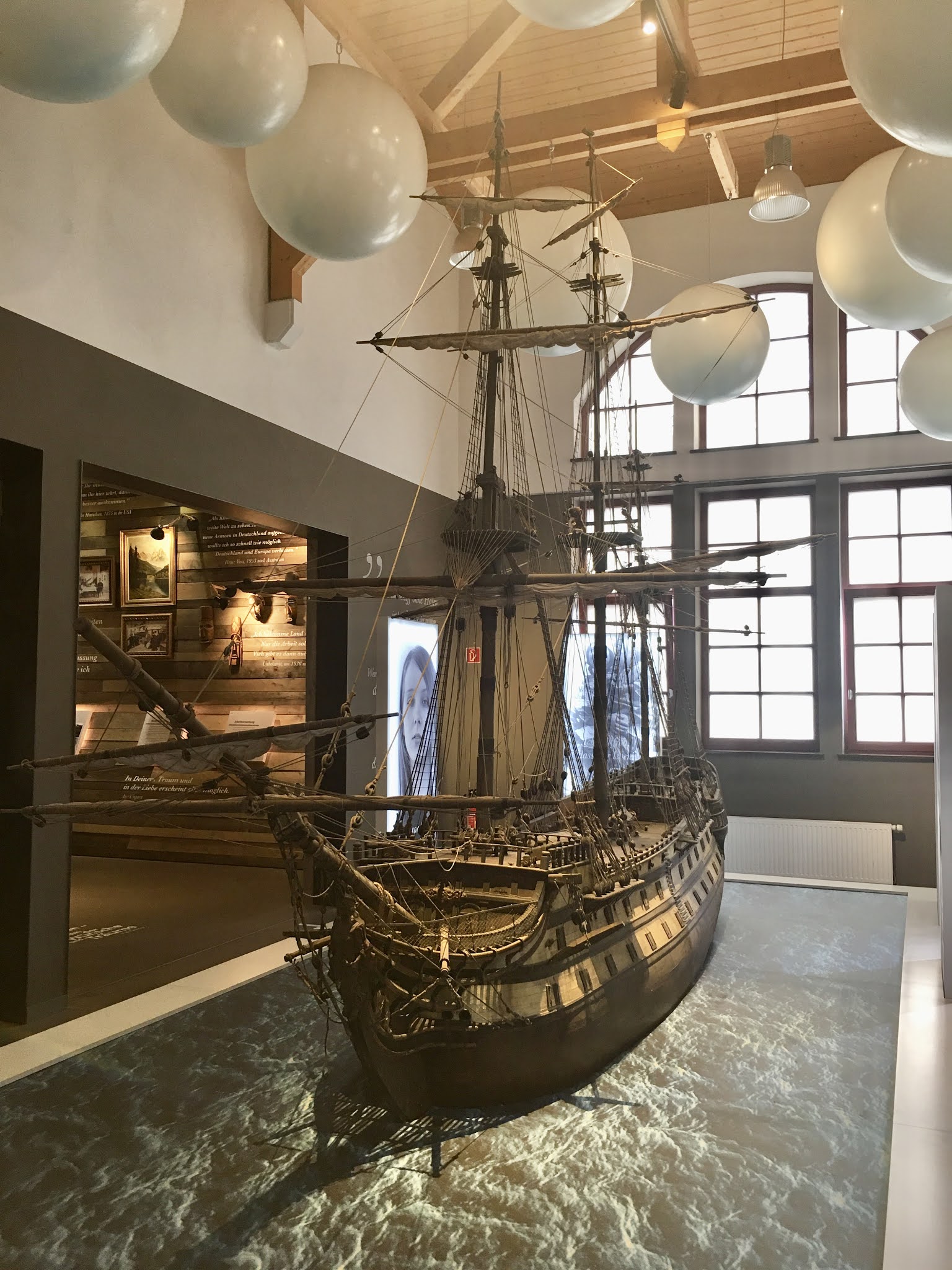

Well. It came from somewhere else. In fact, WE came from somewhere else. With the never-ending tide of arguments on immigration policy in the United States, it would serve us well to think hard back to our ancestors. Ballinstadt does just that: it takes you back.


There is absolutely a high chance that my ancestors walked through the very same emigration halls on their way to America. We all come from somewhere, and most of my heritage can be traced to Germany and Ireland. One of my maternal ancestors, Mattheus Schoch, came to Pennsylvania from Germany to work as an indentured servant for several years before securing his free status.


These people — just as real as you or me — took very real risks and made huge sacrifices to uproot their entire lives to pursue what would hopefully be a brighter future for themselves and their families.


Once they got on the ship, there was no turning back. Some wouldn’t survive the trip, some boats sank, and, for sure, not everyone found what they were looking for upon their arrival.


But The American Dream was such a powerful concept to draw literally millions of people away from their homeland. I understand that my own move back to the Old World is a bit of a reverse ideal, but I like to think that I am honoring my heritage by now speaking German and representing America back in the home country.
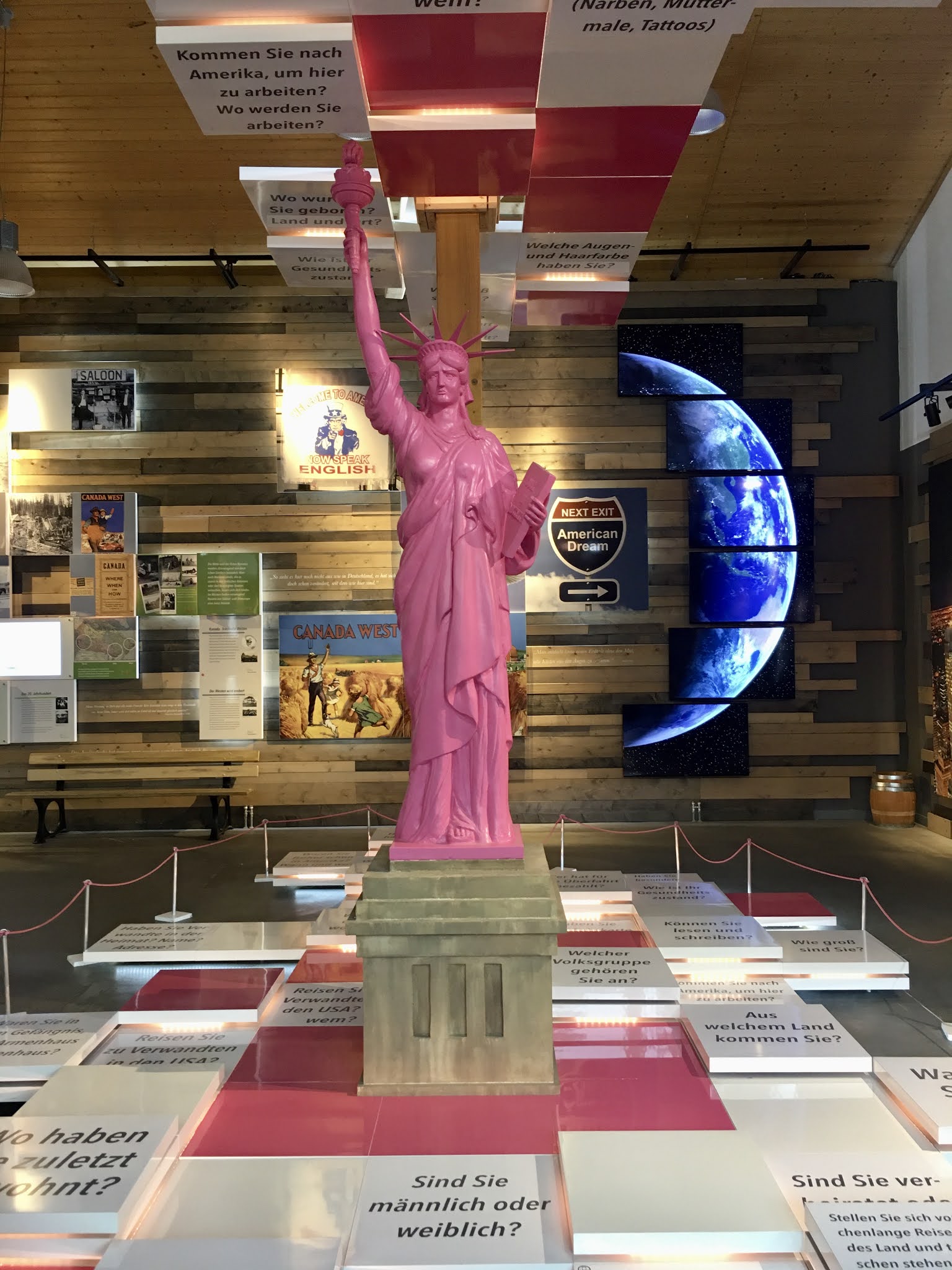

These questions surrounding Lady Liberty are very poignant to me because I have been asked the same questions as an immigrant in France and Germany. I can actually relate to the anxiety of making sure the question is understood to produce the correct answer and the stress of knowing that one wrong move could prevent my papers from being approved. From emigrant status in your home country to immigrant status in your new country, there is a huge shift in acceptance and support. An emigrant leaves their home country usually with a slap on the back, cheers, and “good for you’s” all around. An immigrant arrives in their new country to difficult paperwork in another language, suspicious border control officials, and a severe lack of easy access to resources.


For our personal arrivals to new countries, simple tasks like getting a doctor appointment or asking for directions became overwhelmingly difficult. It took three months to get an internet connection. We drank tea for medicine when our imported supply ran out. We gave up trying to find super specific ingredients in stores. If we couldn’t figure it out on our own or through a local friend, whatever it was had to become part of the past. New solutions were found; we had to adapt.


And our immigration story has been EASY, compared to most accounts. For as stressful and frustrating as our journey has been over the past decade, we are very grateful for our experience and aware that most immigrants to many modern countries have not had the same opportunities or connections as we have had. 


This display reminds its readers, “Don’t forget your German language!” As 21st century Americans, we do not realize how much World War I and World War II severely impacted our cultural heritage. Take the time to do some research on German settlements, schools, and churches in America before World War I struck. The Midwest was basically German. After WWI, there was a push for more “Americanization” and German culture in America began to diminish. By the time Hitler shoved his way to the front of global uproar, speaking German in America became seen as anti-American. 


This poster is interesting for WAY too many reasons.


Basically, from 1914 until 1945, the German heritage in America transitioned to melding with other white European heritages with the English language, but retained so much of the cultural tendencies I mentioned earlier in this post.


I don’t mind being an immigrant. In most ways, I get to identify as an “expatriate,” which is essentially a snobby way to say “successful immigrant.” I wish it were easier for everyone who wants to live and work in another country to get the right documentation. I have been undocumented before, and it is not fun or exciting. 

For Americans, it is easy to jump on the anti-immigration bandwagon because “they will steal our jobs,” “they won’t pay taxes,” “they don’t speak English,” etc. It would do us well to remember the reality of our ancestors who were also likely discriminated against and not trusted when they entered the American Dream. Just because we “feel” American due to decades or even centuries of integration and forgetting the past, does not change the fact that most of our “American” ancestors were born from immigrants. Our family trees are FULL of immigrants; these people made the decisions that ended up allowing us our American status! 

Can we imagine if these German immigrant families had been separated—children from parents—upon entry into their “better future” in the United States?!

It would do us even better to remember the reality that the white American ancestry stole the land from, enforced taxes upon, and mandated English and religious learning for the actual Native Americans and indigenous peoples of the Americas.

America was born on borrowed [stolen] land. Since we are not going to give it back anytime soon, then it only makes sense to share it with the same kind of brave people as our Great-Great-Great-Great-Great-Great-Great-Grandfathers, like Mattheus Schoch.


Continue »

March 7, 2019

9 Things I Learned in My First Season Abroad

Check out my feature article on 9INE POINT!!!

9 Things I Learned in My First Season Abroad


Highlights include learning about talking to strangers, charades, winter, driving, cooking, cell phones, and solo travel!

Also take the time to explore the 9INE POINT website for so many great articles for athletes and subscribe to the magazine and the app here!!!

Continue »

September 3, 2018

VLOG: Vitoria-Gasteiz & Festival of the Virgen Blanca

I had an absolutely perfect half week in the Basque country of Spain. One day to stroll San Sebastián, a few days to absorb the art that is Bilbao, and my day trip to Vitoria-Gasteiz - where I happened upon their Festival of the Virgen Blanca!


It was a bit haphazard, as I didn't know the schedule or where events were happening, but I stumbled upon enough great moments of games, food stands, and plaza dancing to keep my wandering entertained for the whole day.

Vitoria-Gasteiz is actually the government capital of the Basque Autonomous Community of Spain. The city is situated on several different levels that keep the visitor climbing beautiful steps to new terraced views, cathedrals, and squares. I am so glad I chose this city for my day trip! It was easy to take the bus from Bilbao to Vitoria-Gasteiz (around €6), then I chose to return to Bilbao via BlaBlaCar carpool (about €4) so I could practice my Spanish with the driver. Even without the festival going (always August 4th-9th), Vitoria-Gasteiz has so much to offer in history, architecture, and culture, and I hope you have the chance to experience it like I did.


Continue »

August 15, 2018

Bilbao Outdoor Art Walk

Bilbao, Spain, is home to one of three fantastic Guggenheim museums (the other two are in New York City, USA, and Venice, Italy). I haven't been to the other two, but my trip to Bilbao was sure to include this one. However, the city of Bilbao itself is an outdoor art and architecture walk just waiting to be enjoyed. The green spaces, old buildings and churches, and various outdoor displays make this walk around the newer part of Bilbao a great introduction to the current culture of the city and finishes at the Guggenheim to top it all off.

Let's get started at the Jardines de Albia Lorategiak. Notice, most location names in Bilbao also come with a Basque translation. Bilbao is Bilbo, and this park is also called Albiako Loretegiak. Knowing both names can come in handy, as not all signs show both Spanish and Basque!


This is one of my favorite fountains ever. So simple, so serene, and I think a "raining umbrella" would be an excellent invention for hot days.


The Iglesia de San Vicente stands to the north of the park and welcomes visitors with its beautiful sculptures and gardens.

Making our way northwest on Colón de Larreátegui Kalea, we will soon end up in Jado Plaza with the Fuente de los Leones, the Fountain of the Lions.


Next steps are toward Moyua Plaza via Ercilla Kalea, where you will find this gem of a building called the Txabarri Jauregia, a former palace. The square is a hub for the west side of Bilbao with several bus stops, shops, and services available. It's also the easiest place to go to and from the Bilbao airport by bus.


After spending time walking around some busy city streets, we are going to head into the largest green space in Bilbao, the Casilda Iturrizar Parkea, just behind the Museum of Fine Arts.


Take your time wandering through this park to admire the interesting fountains, landscapes, birdlife, duck pond, and people.


As we reach an upward slope in the center of the park, we will be facing the Pergola del Parque de Doña Casilda. It's a quick minute to the shady portico area, overgrown beautifully with vines and mossy plants.


I especially liked the tiling on the floors and columns, and it is probably the best place to read a book and take an outdoor nap in Bilbao.


Leaving the Pergola area on the other side, pretty fountains await you as well as this detailed Estatua de Doña Casilda Iturrizar, the namesake of these gardens and the donor of the land.


As we exit the northwest side of the park, we head back into the city area, where we find the huge Palacio Euskalduna. This event venue has various artistic areas in the front, including this root-like mass. On the way toward the river, there is also an array of geometric street lights that seem to be fashioned after trees.


At this point, we cross the river Ría del Nervión O de Bilbao, peeking down to the left at the Maritime Museum and dockyards. But we are on our way to a more curious attraction: the Tigrearen Eraikina, more easily understood as the Tiger Building. The building was home to Correas el Tigre and built in 1941. The tiger was added in 1942, and stands out from all the rest of the buildings along the waterfront park area.


It's best to continue walking along this side of the river in our approach to the Guggenheim. We can cross the river on the pedestrian bridge of Pasarela Pedro Arrupe and have excellent views of the museum's twists, turns, and curves the whole way.


Going along the side to the front of the museum will bring us to the giant flower "Puppy" that is regularly tended to and updated with new colors.


Basque: Ongi etorri! English: Welcome! We have arrived at the Bilbao Guggenheim, and I do hope you have the time to enjoy the interior and art exhibits. When I went in early August, 2018, an absolutely majestic exhibit by Joana Vasconcelos called "I'm Your Mirror" was on display. I'm not one to really sink my teeth into modern art, but her pieces were awesome (Cinderella's coach reimagined as a helicopter, giant high heels made out of pots and lids, large gun made out of old dial-up telephones, an ironic chandelier that cracked me up, and the key piece of a larger-than-life masquerade mask made out of gorgeous antique-like mirrors). I'm positive whatever the Guggenheim puts on display has similar intensity and creativity and is not to be missed!

*Also, make sure you reserve your tickets in advance online if you do not want to wait around. Typically, the museum is most busy in the mornings and the crowds thin out a bit more in the afternoon.


Bilbao Outdoor Art Walk on iOS & Android
Find the rest of my navigational GPSmyCity app article cities HERE.

Continue »

July 5, 2018

VLOG: Thoughts in Budapest

I've already delved into what Budapest looks like in Snapshots in Budapest, and what is an awesome way to spend your 3 Days Best in Budapest.

But my totally honest thoughts on the city? They are here in this VLOG!


Snapshots in Budapest


3 Days Best in Budapest


German Swag 101: Dresden Polaroids


Get in on Dresden


Other places mentioned in this VLOG:

Paris, Nazaré, Milan, Salzburg, Ljubljana...and all of Spain.


Continue »

October 19, 2017

Monique Vient en Bavière

Vilsbiburg, Landshut, Munich, et Salzburg, voilà!

This post is a bit bilingual, so find the paragraphs you understand and enjoy!

Ce post est un peu bilingue, alors trouvez les paragraphes que vous comprenez et amusez-vous!


My famous French teacher, Monique, graced us with her presence for nearly a full week! Our home transformed into a French zone, and we had a wonderful time showing her around our German world.


Mon célèbre professeur de français Monique nous a honorés de sa présence pendant près d'une semaine. Notre << chez nous >> s'est transformé en zone française, et nous avons passé un très bon moment ensemble dans notre monde allemand.


It was Monique's first time ever in Germany. As the daughter of Polish immigrants to France during the late 1930's, let's just say she didn't grow up in a family too keen on spending time over the eastern border.


C'était la premiere fois que Monique venait en Allemagne. Fille d'immigrés polonais arrivés en France pendant les années 30, on peut dire qu'elle n'était pas dans une famille qui voulait repasser la frontière vers l'est.


But the world moves forward, and we all have increased mobility, freedom, and security throughout. Monique came to visit us in California back in 2013, so this journey "next door" to Germany was much easier to make happen.


Mais le monde évolue, et tout le monde peut encore bouger, être libre et en securité partout. Monique est venue nous voir en Californie en 2013, alors ce voyage "au voisin" Allemand était beaucoup plus facile à organiser.


She also happened to come during the exact one week of good weather, so we thank Monique for being our French sunshine. We got to walk around everyday in a new city and the autumn colors were perfect!


Elle est venue juste pendant la seule semaine de beau temps, donc on remercie Monique, notre soleil français. Nous avons visité à pied une ville différent chaque jour et les couleurs d'automne étaient parfaites!


Merci Monique et à bientôt!


Continue »