Showing posts with label Cultural Differences. Show all posts

July 25, 2020

German Swag 101: The Integrated Immigrant - Americans

The only reason I knew about the Ballinstadt Museum in Hamburg was because it was advertised on the back of a city map that someone left at our apartment after a visit. I can’t for the life of me remember who went through Hamburg on their way to us, but there was the map in my travel keepsakes box, calling me north. I opened the map for the first time on the last leg of my train journey, and the Ballinstadt Emigrant Museum immediately spurred my interest.


What a totally cool and unique experience this museum is! There was an entire compound village in this area that Albert Ballin — son of Danish-Jewish immigrants to Germany — built to house and prepare Germans for their grand voyage across the ocean to the New World. This compound functioned throughout the nineteenth century and just until the 1930s when the Nazis came to power.


Over 5 million Germans journeyed from Hamburg during this time period, many of whom are the reason some crazy percentage of over 60% of white Americans have German heritage. My natural assumption based on our school history classes was that white Americans descended mostly from British heritage. Not. Even. Close.


Living in Germany has taught me SO many things about my own heritage and also more history about America. Like about beer culture and why more breweries have German-derivative sounding names. About dinner time being appropriately on time at 5 p.m. About being early as a virtue. Kindergarten, meat and potatoes, the way white people garden and landscape, the reason older interior design was NOT open-concept, and so many other unnoticed things we take for granted as part of American culture. 
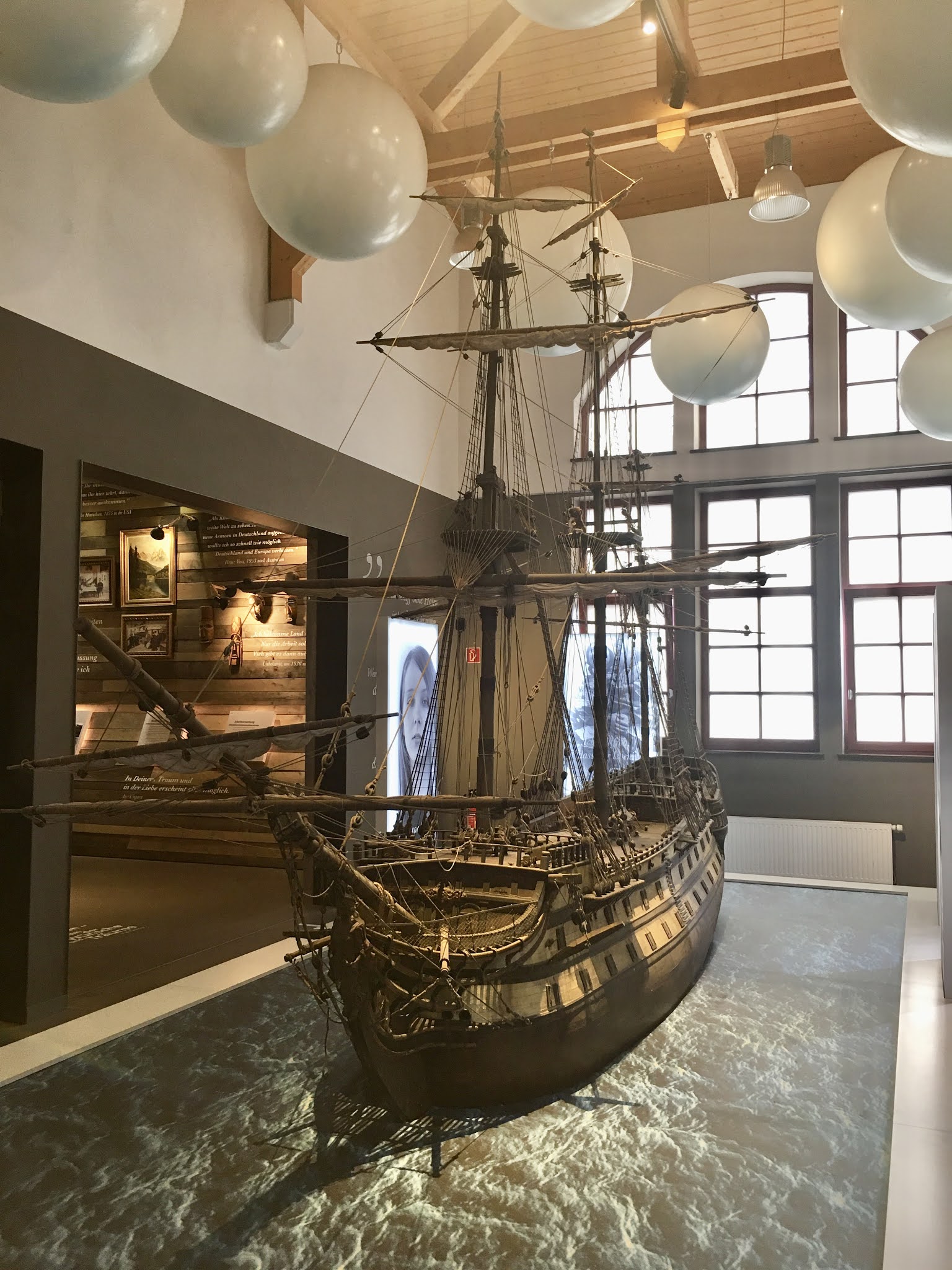

Well. It came from somewhere else. In fact, WE came from somewhere else. With the never-ending tide of arguments on immigration policy in the United States, it would serve us well to think hard back to our ancestors. Ballinstadt does just that: it takes you back.


There is absolutely a high chance that my ancestors walked through the very same emigration halls on their way to America. We all come from somewhere, and most of my heritage can be traced to Germany and Ireland. One of my maternal ancestors, Mattheus Schoch, came to Pennsylvania from Germany to work as an indentured servant for several years before securing his free status.


These people — just as real as you or me — took very real risks and made huge sacrifices to uproot their entire lives to pursue what would hopefully be a brighter future for themselves and their families.


Once they got on the ship, there was no turning back. Some wouldn’t survive the trip, some boats sank, and, for sure, not everyone found what they were looking for upon their arrival.


But The American Dream was such a powerful concept to draw literally millions of people away from their homeland. I understand that my own move back to the Old World is a bit of a reverse ideal, but I like to think that I am honoring my heritage by now speaking German and representing America back in the home country.
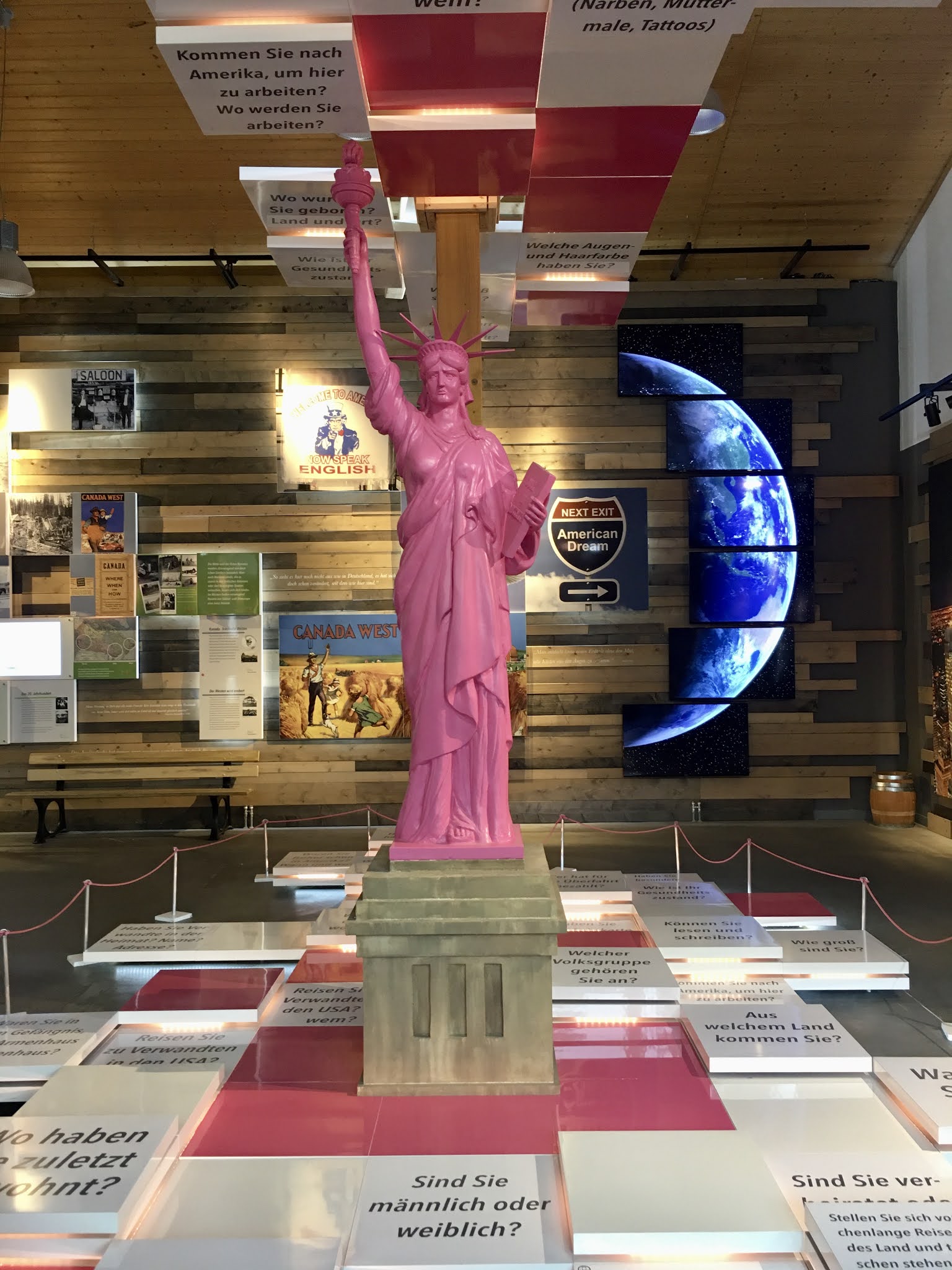

These questions surrounding Lady Liberty are very poignant to me because I have been asked the same questions as an immigrant in France and Germany. I can actually relate to the anxiety of making sure the question is understood to produce the correct answer and the stress of knowing that one wrong move could prevent my papers from being approved. From emigrant status in your home country to immigrant status in your new country, there is a huge shift in acceptance and support. An emigrant leaves their home country usually with a slap on the back, cheers, and “good for you’s” all around. An immigrant arrives in their new country to difficult paperwork in another language, suspicious border control officials, and a severe lack of easy access to resources.


For our personal arrivals to new countries, simple tasks like getting a doctor appointment or asking for directions became overwhelmingly difficult. It took three months to get an internet connection. We drank tea for medicine when our imported supply ran out. We gave up trying to find super specific ingredients in stores. If we couldn’t figure it out on our own or through a local friend, whatever it was had to become part of the past. New solutions were found; we had to adapt.


And our immigration story has been EASY, compared to most accounts. For as stressful and frustrating as our journey has been over the past decade, we are very grateful for our experience and aware that most immigrants to many modern countries have not had the same opportunities or connections as we have had. 


This display reminds its readers, “Don’t forget your German language!” As 21st century Americans, we do not realize how much World War I and World War II severely impacted our cultural heritage. Take the time to do some research on German settlements, schools, and churches in America before World War I struck. The Midwest was basically German. After WWI, there was a push for more “Americanization” and German culture in America began to diminish. By the time Hitler shoved his way to the front of global uproar, speaking German in America became seen as anti-American. 


This poster is interesting for WAY too many reasons.


Basically, from 1914 until 1945, the German heritage in America transitioned to melding with other white European heritages with the English language, but retained so much of the cultural tendencies I mentioned earlier in this post.


I don’t mind being an immigrant. In most ways, I get to identify as an “expatriate,” which is essentially a snobby way to say “successful immigrant.” I wish it were easier for everyone who wants to live and work in another country to get the right documentation. I have been undocumented before, and it is not fun or exciting. 

For Americans, it is easy to jump on the anti-immigration bandwagon because “they will steal our jobs,” “they won’t pay taxes,” “they don’t speak English,” etc. It would do us well to remember the reality of our ancestors who were also likely discriminated against and not trusted when they entered the American Dream. Just because we “feel” American due to decades or even centuries of integration and forgetting the past, does not change the fact that most of our “American” ancestors were born from immigrants. Our family trees are FULL of immigrants; these people made the decisions that ended up allowing us our American status! 

Can we imagine if these German immigrant families had been separated—children from parents—upon entry into their “better future” in the United States?!

It would do us even better to remember the reality that the white American ancestry stole the land from, enforced taxes upon, and mandated English and religious learning for the actual Native Americans and indigenous peoples of the Americas.

America was born on borrowed [stolen] land. Since we are not going to give it back anytime soon, then it only makes sense to share it with the same kind of brave people as our Great-Great-Great-Great-Great-Great-Great-Grandfathers, like Mattheus Schoch.


Continue »

June 11, 2020

I Thought Not Being Racist Was Enough

There is no right way to write this kind of post. I have been thinking about it for several days now, trying to figure out the correct stories to reference, how to present the various angles, and how to communicate the intention and purpose in a way that helps and does not hinder the current narrative on anti-racism.


I know writing about racism as a middle-class white woman might be redundant and offensive to some, but I truly hope that this can contribute to the growth and understanding for everyone. Ultimately, I have consulted with different sources and have determined that writing this is worth whatever the risk may be to at least make my stance clear in support of anti-racism.


My journey is very whitewashed, but hang with me, please, as there are likely a lot of white people who seem to be going through a similar process and we all just want to get to the right place together.


I also want to be very clear that I am not “making things up” for my younger self; I have kept journals since I was ten years old and have always been a very self-reflective person with an acute memory for how I thought and felt as I grew up. 


Growing Up Without Racism


The following statement may seem impossible, but it’s 100% true.


I grew up in a world without racism.


WHAT?!


Well, obviously, THE world was not without racism, but mine really seemed to be. We lived in small suburban areas in Northern California. I can count on one hand how many black classmates I had from preschool through graduating high school. We learned about the history of slavery as something horrible; something horrible us West Coast people would have never done (when, in reality, most of our white ancestors who had migrated from the Midwest and East Coast had likely been slaveowners).


Honestly, the most exposure I had to African-American culture was on television and movies. Sitcoms, dramas, talk shows, game shows, and sports had plenty of positive diverse role models in the 1990s. My parents never said anything negative about other races. As God-fearing parents of two daughters, their main theme for pushing us was that we could be anything we wanted to be [in a man’s world] and that all of us were children of God and equally loved in Christ.


This always made sense to me. They raised us to be colorblind and not racist. We learned very late about curse words and racial slurs, and both sets of vocabulary did not belong in our communication. 


Here is what I believed about black people when I was child.


Black people were beautiful. 

Tyra Banks. Halle Berry. Will Smith. Denzel Washington.


Black people were strong. 

Muhammed Ali. Michael Jordan. Serena Williams. Jesse Owens.


Black people were passionate. 

Martin Luther King, Jr. Sidney Poitier. Aretha Franklin. Ella Fitzgerald.


Black people were intelligent. 

Oprah. George Washington Carver. Colin Powell. Condoleeza Rice.


Black people were heroic. 

Rosa Parks. Harriet Tubman. Sojourner Truth. Jackie Robinson.


I believed these things so much to the point that I had no problem expressing what I understand now to be my version of natural positive racism.


“I wish I had been born black.”


I wanted to be better at sports, to be a better singer, to be able to dance, and to have naturally dark skin and really cool hair. This was not rocket science. Black was better.


Apparently, after my simple childlike honesty, an older relative had later quietly confronted my mother, asking her, “Did Christy really mean that she wishes she were black?” When my mom relayed to me the relative’s shock, I was just as surprised.


“Why wouldn’t I want to be black?!”


Growing up in a world devoid of racism to the point where I thought black was better was how white privilege played out for me.


Learning About Racism From A White Perspective


As a young adult, I read three books that really began to open my mind about racism. Yes, these books were written by two white women. But as a person from the West Coast, I could not get a handle on why slavery had even existed in the first place, why the Ku Klux Klan was even a thing, or why racist stories from the South still kept coming up in conversations.


Harper Lee first wrote Go, Set a Watchman. Apparently, that manuscript was rejected in 1960, and so she wrote a prequel, the well-known and loved To Kill a Mockingbird. Atticus Finch was established as the great lawyer against racism, the lone ranger standing up for the rights of mankind in the South. Then Go, Set a Watchman was posthumously published in 2015, and everyone realized that the racial complications in the South were much more layered and very complex. The daughter, Scout, was the real hero and potential agent of change in the culture. 


What I find interesting about Lee’s perspective was that she wanted to expose the complications of systemic racism in 1960, and the publishers essentially would not let her. So she had to “dumb it down” and make the white lawyer father the hero instead of the not-so-upright quasi-neutral villain she had originally intended Atticus Finch to be.


Scout is the hero because she realizes something is wrong, and she understands that she has to do something different about it. Even if it will be a struggle.


Gone With the Wind was the other book that started to expose the terrors of the Civil War for both sides for me. Obviously, slavery was wrong. Plantation owners had their entire lives turned upside down because they had played along with the falsely secure systemic racism of slavery, and during the Reconstruction Era, their lives took a totally different turn. What I learned from this fictional work was that before the Civil War, it had been bad for black people, then after the Civil War, it was bad for everybody. The division and mistrust between the communities was so deep and so severe that “recovery” was going to end up a ragged and grueling process (that is still not complete).


Note: the book is over a thousand pages, but digs much deeper into the racism issues than the movie ever does.


Being a young adult exposed me to more comments from various sources about “how the neighborhood had changed,” about how it didn’t work out for someone when they dated a black person, and about general suspicion of “them.” 


My world was still basically “without” racism, and I had no reason to seek it out or find more explanations aside from what I found in books or on the internet.


Deciding Not Being Racist Was Enough


I never had to deal with “deciding” if I would be racist or not. I just wasn’t. I didn’t have any negative feelings or reactions toward African-Americans, Hispanics, Asians, Native Americans, Jews, Arabs, or any other “other.”


Because I was not faced with racism on a regular basis, it didn’t need to be a serious issue for me to deal with or confront. My non-white friends and I tried to not take our “racial status” seriously and joked about the stereotypes that we did not feel were relevant to us.


I wonder now if they were joking because they felt the same way, or if they were just trying to save face around me because I didn’t think race was important.


I 100% believed that if we just all stopped talking about race as if our differences were a negative thing, that it would go away. I thought it was a mass media strategy to overemphasize our differences in an effort to divide us further.


So, I took the position that racism was irrelevant to me and therefore those who wanted to talk about it over and over again were just making matters worse.


Realizing Why Anti-Racism & “Black Lives [DO] Matter”


I think it’s really important at this point to be very clear that this should not be a political party issue. I know it seems very much like “Republicans are racist” because of the current political climate and leadership. But as racism in America has been exposed as built into the actual foundational system, this means that ALL political parties have also been systematically racist. 


As evidenced by only ONE president out of forty-five in the history of the United States who has not been a well-to-do white male.


If the system needs to be broken down and rebuilt, I believe this wholly extends to both the Republican and Democrat political parties.


Enough about political parties and systems, though. If I also dive too deeply into the police state, incarceration, and public funding complexities right now, this will be a book and not an essay.


This is a humanitarian issue, and we are all human and bleed red.


The sign regularly shared on social media this past week explained it best.


“We said ‘Black lives matter.’ We never said ‘only Black lives matter.’ We know ‘all lives matter.’ We just need your help with #BlackLivesMatter for Black lives are in danger!” 


THIS IS GOLD. It’s simple, it’s clear, and it’s true.


I have been very selective about what I have decided to share and repost to social media throughout the past week. I did not want to be a “bandwagoner” or someone who just jumped on the trending hashtags to forget about it the week after. I wanted to try to understand how I could help this cause in an uplifting and positive manner. 


This is my small effort to express the realization that white privilege does not always look like yachts and mansions. White privilege is also the innocence of not having to deal with racism in a personal way.


Conclusion


I’m not going to sit here and count how many black and mixed people I know or are friends with or love. I live a very white life in a very white country (Germany) and the only time I have ever felt singled out for the way I look with blonde hair and blue eyes and white skin was for four days when I visited Morocco.


Four days. Out of over 12,000 days.


People are people. We all have our individual stories, our struggles, our successes. But for whatever our struggles as white people, or more specifically as white women have been, we as a group have not collectively been oppressed. We have actually had the most privilege and most opportunities for our gender.


Black people need us (us, as in EVERYONE) right now to be honest about our thought processes and feelings. Black people need us to not just remind each other that racism is wrong, but to TELL each other that racism is wrong and that we will not accept that kind of talk or behavior anymore.


I love that my generation of Millennials appears to be spearheading the change, but we have got to SUSTAIN it. The people who would rather chill in the safety of their comfortable systemic racism are totally hoping they can just ride this out one more time and things will “go back to normal.”


I have said a lot of things in this post that I have felt at different points in my life that maybe you agree with, maybe you don’t.


But there is something that I absolutely still stand by and will until the day I die.


Black people are beautiful. 


Black people are strong. 


Black people are passionate. 


Black people are intelligent. 


Black people are heroic. 


BLACK PEOPLE ARE IMPORTANT, and not just because they’re awesome, or we know or love them, but because they are made in the image of God and we are all equal in His sight. Even “outside” of any belief system, we can all agree that humans deserve basic rights to be treated with dignity and respect.


I understand now that I can’t understand being black.


“I understand that I will never understand; however, I stand with you.”


How we take our stand against racism now and everyday is absolutely going to make a difference. We can “stand” on social media, in demonstrations, and on our platforms. But our stand means nothing if it doesn’t first come from our hearts and show in our relationships. It means even less if we only were able to “sustain our stand” in the beginnings of the social movement. We need lasting change, and it begins in ourselves.


Let’s decide to be anti-racist and be the generation that takes a giant step forward in making the world a better place for black people. Finally.


P.S. Can we all just agree to push Oprah to run for president on a New World Party nomination come November?


“Turn your wounds into wisdom.” - Oprah


Let’s pray for courage, wisdom, and perseverance. And not stop until we have it for everyone.


Continue »

September 23, 2019

Road Trip to Ribeira + Padrón

While I was stationed in Santiago de Compostela in the Galician region in the northwest of Spain for a week, I embarked on my own version of a pilgrimage. My pilgrimage just involved food and roots, instead of footpaths and relics.


Marc's Spanish side of his family heritage hails from the bustling fishing port town of Ribeira (also written as "Riveira"), which is only a one hour drive from Santiago. Over the years, we have all worked on making various connections with the authentic Vilas familia, meeting cousins in New Jersey and London. The actual family tree is a bit crazy to try to figure out, but everyone can be happy with being cousins.


Fortune would have it that as a I researched the route to drive from Santiago to Ribeira that the city of Padrón popped up right along the way. The popular tapas menu item of pimientos de Padrón has been a favorite of Marc's and mine for a while now. Of course, I made a snack stop! The little green peppers were delicious, but the only convenient difference I really noticed was that they clipped all the stems so you could just eat the whole pepper. Still glad I made the stop, though!


Ribeira itself sits in a harbor of beach and port, smelling like salt and fish with the sounds of seagulls and sailors. It unfolds itself from the green hills that tumble into sandy coastline in Galicia. I had a lovely time with Ana and Maria, who patiently dealt with my weak Spanish, took me to an unbelievably delicious restaurant, a tour of the ocean viewpoints, and graciously hosted me for the evening! ¡Muchas gracias!


I am so happy I was able to make this little day trip and hope to bring more of the actual Vilas family with me next time!

Continue »

September 6, 2019

When You Get to Santiago de Compostela

I have never been to a place quite like Santiago de Compostela.


The overwhelming majority of people walking around are pilgrims. They have huge backpacks with neon sleep mats and they clickety-clack with their walking sticks. There are sounds of bagpipes wailing from the buskers in the parks. The damp raininess lends a greenish tint to the vegetation and the buildings that somehow have tufts of wildflowers growing out of the stone on even the fourth or fifth floor. There are scallop shell symbols on the ground, on the walls, and on the signs. There are sounds of cheering in front of the cathedral, and also around the town as groups even sight the cathedral for the first time.


I think this is something akin to the Catholic version of Mecca. Maybe it would be similar for a Protestant Christian in Bethlehem, or at Golgotha. I can relate it to when I first saw the Eiffel Tower, perhaps.


It's also incredible because Santiago de Compostela has been a tourist destination for over a thousand years. Pilgrimage tourism literally built this city.


It has been a very interesting place to spend six days. I don't know if I will be able to return, or for how long, but I know that I would be curious to talk to more people, both locals and visitors, the next time. There is a common ground with nearly everyone here, but it would still be an interesting compilation of stories and trails to listen to what brought every individual along the Camino to end up in Santiago.


This is my list of sights, food and coffee places, parks, stores, and services that I found useful and helpful during my time here.


I really loved my hotel, the PR Plaza de Galicia. You can use my Booking.com referral link to book and we will both get a discount! I had views over the square and of the cathedral, all complete with my own double bed and full bathroom. Very private and I got a ton of work done during my down time. The Plaza de Galicia is also where the airport bus stops, and I found the location to be both central and also a little bit away from the extremely touristed areas.


I rented a car from the Hertz dealership in town at La Galuresa where there is also a gasoline station. The lady working the desk was British and, of course, fluent in English and Spanish. She was so helpful! It is also possible to rent cars from the airport, too, but I only needed it for one day (trip to Padrón and Ribeira) and it was so much easier to just walk to the rental location than to take the bus to the airport again.


The post office "Correos" on Rúa do Franco had some of the nicest postal service staff I have ever met. Very understanding of tourists wanting to send postcards to various countries!


I recommend stopping by the bookstore, Re-Read Santiago, to find or turn in used books. I found They Came to Baghdad by Agatha Christie there and was able to enjoy reading it on a sunny day in the nearby Parque de Alameda.


On the other side of the Parque de Alameda is a great viewpoint to take pictures of the cathedral, at the Miradoiro da Catedral. Another interesting park with maze-like walls and hedges is the Parque de Belvís on the east side of the center. This park leads you to the Convento de Belvís and is also close to the large local Mercado de Abastos de Santiago.


Other sights to take in are the Praza das Praterías on the way to the grand Catedral de Santiago de Compostela. Both of these locations deserve at least a few minutes of reverent quietude to observe how meaningful this destination has been for the majority of the people present.


The University Library is also worth a walk through, and hopefully the gorgeous Biblioteca América section will be open to enjoy.


For meals, my absolute favorite place to eat in Santiago was at Valentina Taquería. The Argentinian lady who is cooking these awesome tacos, tamales, and quesadillas is Rosa, and she is the main friend I made during my week here...mostly because I ate here once every day! It was really easy to place my order on the computer screen, I could pay immediately, then enjoy my meal at my leisure, either in the passageway where the taquería is located or take it out to the park. Rosa also let me practice my Spanish with her and her niece when I went over to her house for her niece to give me a manicure and pedicure! She is an A+ person, who also happens to make really delicious food! I recommend the carnitas and the guacomole, plus a mani/pedi!!!


The other place I ate a few meals at was Antollos pinchos e viños. They have a solid menu of classic tapas, and also a tapas bar where you can just select the ones you want from sight. For breakfast, coffee, snacks, etc., the places I liked the most were Cafe Iacobus, Cafetería La Flor, and Café Tertulia. I also had some delicious ice cream from Xearte Brigitte (which is along the main Camino and makes for excellent people watching!) and Smooy (although this was a little pricey). I am not just listing off all the places I went to; there were other locations I ate and drank at as well, but they were mediocre and are not worth mentioning.


A special note about Cafe Iacobus; it ebbs and flows with crowds, so it's good to just wait a few minutes and then take a seat. I sat at the bar and ordered one of the many coffee + chocolate drink options, the traditional Tarta Santiago cake, a Spanish tortilla omelette, and fresh orange juice.


Both of the older men working the coffee bar on the different days I went were kind and attentive, and even supplied me with a complimentary pastry toward the end of my breakfast! This was the only cafe that felt traditionally personable and effortlessly charming; I think I can say that this cafe has duende.


There are plenty of other religious sights and decent places to eat in the city center, but these were my favorite and contributed to my very wonderful first time in Santiago de Compostela.


 GPSmyCity


Find the rest of my navigational GPSmyCity app article cities HERE.

Continue »